

iOS App · AI Vision · Pregnancy Reference
BumpCheck — trimester-aware ingredient reference for cosmetics, medications, and food
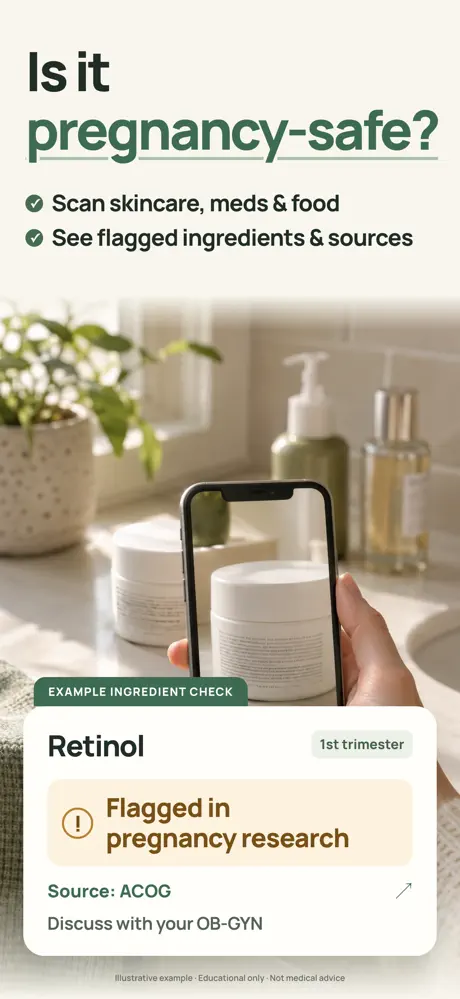
Six weeks pregnant and staring at a retinol moisturizer at 11 p.m. Or wondering if Tylenol is okay at 2 a.m. with a fever. Four input modes — barcode scan, label photo, paste text, or medication search — and the app returns educational context from CDC, ACOG, NIH RxNav, NIH LactMed, EWG Skin Deep, CIR, and FDA. Not medical advice.
Overview
What is BumpCheck?
BumpCheck is an iPhone reference tool for pregnant and breastfeeding women — scan a product, search a medication, and get trimester-aware educational context drawn from seven authoritative public health sources.
It is built for the moments every pregnant woman has: standing in Sephora with a retinol moisturizer in hand and wanting a 5-second answer instead of opening four browser tabs. Or at 2 a.m. with a fever, wondering if Tylenol is safe in the first trimester. Or at the fish counter, unsure whether albacore tuna is the right call.
BumpCheck is an educational reference, not a medical service. It does not diagnose, prescribe, or recommend a course of treatment. Every result page in the app says so. It shows you what public guidance says in seconds, so you can bring better questions to your OB-GYN.
BumpCheck is not affiliated with ACOG, CDC, NIH, EWG, CIR, or FDA. All references to these organizations are to the publicly available research they publish.
Audience
Who BumpCheck is built for
First-time mothers
In their twenties and thirties who want peace of mind without spending two hours per question on Google. BumpCheck is designed for the late-night "is this okay?" moment.
Skincare-routine builders
Who had a 10-step routine before pregnancy and now need to know which of their existing products to keep, which to swap, and what to buy as alternatives. EWG Skin Deep covers 70,000+ products, and BumpCheck surfaces that data trimester-by-trimester.
Sick while pregnant
In cold-and-flu season — first trimester plus a sinus infection plus questions about Tylenol, Benadryl, Tums, and Mucinex. BumpCheck searches NIH RxNav and NIH LactMed — the same databases US pharmacies and hospitals use — and returns trimester-specific educational context.
Second-time moms and breastfeeding women
Who already know what they want and use the app across multiple pregnancies and feeding cycles. Breastfeeding context comes from NIH LactMed, which often differs from pregnancy context for the same ingredient.
Capabilities
What BumpCheck covers — four input modes, three categories, seven sources
BumpCheck has four input modes, so you can use whichever is closest at hand.
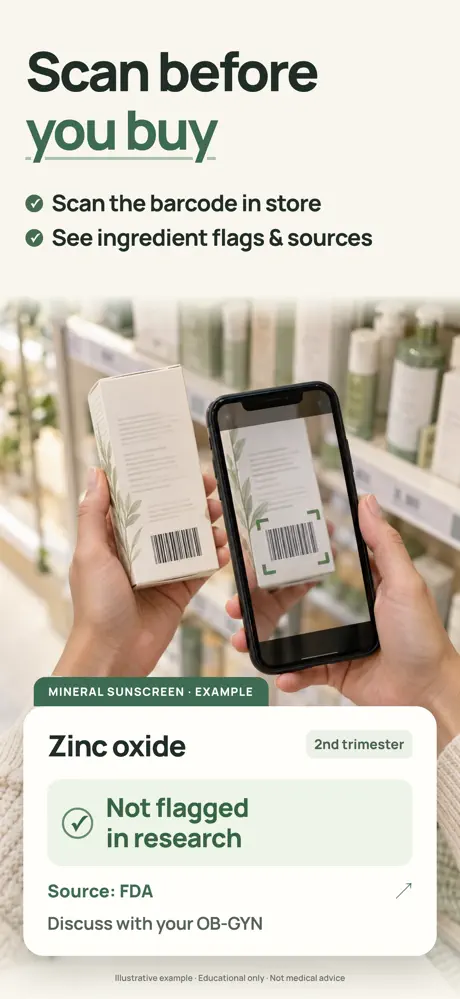
- Scan a barcode — point the camera at any product's UPC code. BumpCheck looks up the full ingredient list and runs each ingredient against the sources for your current pregnancy stage. This is the in-store mode — built for the moment you have 30 seconds before the staff asks if you need help.
- Photograph an ingredient label — when there is no barcode, or the product is an indie brand not in any database. The camera reads the printed text directly using AI vision. Works on labels in any language with Latin characters.
- Paste an ingredient list or product name — for online shopping. Copy the ingredients from a Sephora or Amazon listing and paste into BumpCheck.
- Search medications by brand or generic name — Tylenol, Benadryl, Claritin, Tums, Zofran, or their generic equivalents (acetaminophen, diphenhydramine, loratadine, calcium carbonate, ondansetron). The app queries NIH RxNav and NIH LactMed — the same databases US healthcare professionals use.
Three product categories are covered:
- Cosmetics and skincare — retinoids, salicylic acid, hydroquinone, sunscreen filters (avobenzone, oxybenzone, mineral), essential oils, fragrance, preservatives, peptides, AHAs/BHAs. Sources: EWG Skin Deep (~70,000 products), CIR assessments.
- Medications (OTC and Rx) — pain relievers, antihistamines, antacids, anti-nausea medications, cough/cold, antibiotics. Sources: NIH RxNav, NIH LactMed.
- Food — mercury content categories for fish (swordfish, king mackerel, albacore tuna), listeria risk categories for soft cheeses and deli meats, caffeine guidance, herbal tea cautions, raw food categories (sushi, raw eggs, undercooked meat). Sources: ACOG, CDC, FDA.
Every result page shows the source citation directly under the educational context — linked to the source. If we cite ACOG, the result links to the ACOG publication. If we cite NIH LactMed, the result links to the LactMed monograph. Your OB-GYN can read the same source.
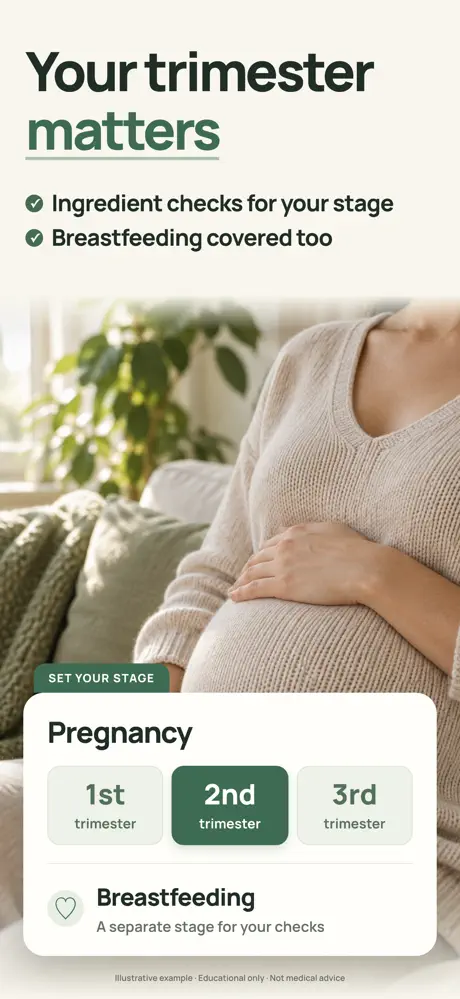
The trimester-aware system supports six stages: Trying to Conceive (TTC), First Trimester (weeks 1–13), Second Trimester (weeks 14–27), Third Trimester (weeks 28–40), Postpartum, and Breastfeeding. You can change your stage at any time in Settings, and previous scans update their context automatically.
Workflow
How it works — five questions that narrow it down
For medications, this is the five-question workflow BumpCheck automates — the same process your OB-GYN's nurse line uses.
- Confirm the active ingredient (generic name).Brand names are marketing — generic names are pharmacology. "Tylenol Cold & Flu Severe" contains acetaminophen plus phenylephrine plus dextromethorphan, each with their own pregnancy considerations. BumpCheck looks up the generic behind the brand automatically. Common conversions: Tylenol = acetaminophen, Benadryl = diphenhydramine, Claritin = loratadine, Sudafed = pseudoephedrine, Mucinex DM = guaifenesin + dextromethorphan, Tums = calcium carbonate.
- Check what the public health databases say.NIH RxNav for general drug information. NIH LactMed for breastfeeding compatibility. ACOG clinical practice bulletins for OB-specific recommendations. EWG Skin Deep for cosmetic ingredients. BumpCheck queries all relevant sources and presents the educational context with citations.
- Apply the trimester-specific guidance.NSAIDs (ibuprofen, naproxen) have specific ACOG concerns after week 20. Pseudoephedrine has a research concern in T1 that is not present in T2. Retinoids have the most concentrated concern in the first trimester during organogenesis. BumpCheck matches the guidance to your current stage — a general search result that does not specify trimester is incomplete.
- Consider dose and duration.A one-time dose is a different question from a multi-week regimen. Lowest effective dose for the shortest needed duration is the default principle in pregnancy. Chronic use (more than 3–5 days continuously) deserves an OB-GYN check-in even for typically-acceptable drugs.
- Know when to call your OB-GYN regardless.Certain situations are always the OB-GYN's call: any prescription medication change, any pre-existing condition, any symptom beyond routine illness, any fever of 100.4°F (38°C) or higher, any concerning fetal movement change after week 20. For these, BumpCheck surfaces the educational context and explicitly redirects you to your provider.
A barcode scan returns context in about 2–3 seconds. A label photo (AI vision text extraction) takes 5–8 seconds. A paste or medication search is nearly instant.
Comparison
BumpCheck vs Little Bean vs MommyMeds vs MamaSkin
An honest side-by-side. BumpCheck is the app for one-stop coverage of cosmetics plus medications plus food — it is not trying to displace Little Bean for cosmetics-only use.
| BumpCheck | Little Bean | MommyMeds | MamaSkin | |
|---|---|---|---|---|
| Scope | Cosmetics + medications + food | Cosmetics & skincare only | Medications only | Cosmetics only |
| Barcode scanner | Yes | No | No | No |
| Photograph ingredient label | Yes | Yes (camera-first) | No | Yes |
| Paste / text search | Yes | Partial | Yes (text only) | Partial |
| Medication reference (OTC) | Yes — NIH RxNav | No | Yes | No |
| Breastfeeding reference | Yes — NIH LactMed | Partial | Yes | No |
| Food category guidance | Yes — ACOG, CDC | No | No | No |
| Trimester-aware (stages) | Yes — 6 stages | Partial | No | No |
| Source citation per result | Yes — linked | Partial | Partial | No |
| Cosmetic coverage | EWG Skin Deep + CIR | ~90 curated ingredients | None | ~150 ingredients |
| App Store reviews | 2026 launch · early reviews | 123K+ users · thousands of reviews | Not updated since 2021 | Active (+22% MoM) |
| Pricing | $39.99 bundle · $79.99/yr · $7.99/wk | ~$9.99/wk · ~$49.99/yr | $9.99 one-time | $4.99/wk |
Where Little Bean clearly wins: Little Bean has had years to refine a mature, well-reviewed, install-base-tested experience focused exclusively on cosmetic ingredients. Their curated database reviewed by an in-house toxicologist and well-developed alternative-product recommendations make them the safest default if you only need cosmetic ingredient checking. We make BumpCheck and we are saying this plainly.
The philosophy difference: Little Bean uses a curated database reviewed by their toxicologist — tighter, more opinionated assessments. BumpCheck aggregates publicly available sources directly (EWG, CIR, NIH, ACOG, CDC, FDA) with citations — more sources you can verify yourself. People who try both often prefer one or the other.
In practice
Situations where BumpCheck helps
Illustrative examples of how the features fit into a day, not user reviews.
The 2 a.m. sinus infection
Anna is 9 weeks pregnant and miserable. Her partner brings home Tylenol, Sudafed, Benadryl, Tums, and Mucinex DM. The OB-GYN office is closed. The five-question workflow: acetaminophen for the fever — acceptable across pregnancy including T1 as first-line per ACOG; pseudoephedrine (Sudafed) — generally avoided in T1 due to research concern, skip it; diphenhydramine (Benadryl) — long safety record in pregnancy; calcium carbonate (Tums) — routinely used across all trimesters; guaifenesin (Mucinex) — generally acceptable at OTC doses. Anna takes Tylenol and Benadryl, skips the Sudafed, and calls the nurse line in the morning to confirm. If the fever reaches 100.4°F (38°C), that becomes the call-the-OB-GYN moment, not a CVS decision.
The Sephora moment
Maya is 6 weeks pregnant and holding a retinol moisturizer she has used for two years. She scans the barcode. BumpCheck returns the ACOG and EWG citations on retinoids in T1 — concentrated research concern during organogenesis. She sets it back on the shelf and asks an associate about mineral SPF options instead. Five seconds, one scan, a decision she can explain to her OB-GYN at her next visit.
The fish counter
Alex is 28 weeks pregnant and at a fish counter. Swordfish, albacore tuna, or salmon? BumpCheck surfaces the ACOG and CDC mercury content categories: swordfish and king mackerel are high-mercury (avoid in pregnancy); albacore tuna is medium (limit to 6 oz per week); salmon is low-mercury (up to 12 oz per week). Decision made without consulting a browser.
The online shopping cart
Sarah is 20 weeks pregnant and buying skincare online. She copies the ingredient list from a serum on Sephora's website, pastes it into BumpCheck. Three ingredients flagged with citations — one is oxybenzone (chemical sunscreen filter, specific concern; note: mineral filters like zinc oxide and titanium dioxide are not in the same concern category). She swaps to the mineral-SPF version of the same brand before checking out.
Pricing
Three tiers, no per-scan fees
Pregnancy Bundle
$39.99 one-time
- No subscription, no auto-renew
- Full pregnancy through breastfeeding
- All four input modes
- All seven reference sources
- Six trimester stages
Weekly
$7.99 / week
- Free trial included
- All four input modes
- All seven reference sources
- Cancel anytime in Apple Settings
Annual
$79.99 / year
- For second-time moms
- Multi-pregnancy use
- All four input modes
- All seven reference sources
- Six trimester stages
The Pregnancy Bundle is a one-time purchase — it never auto-renews and there is nothing to cancel. Weekly and annual subscriptions auto-renew unless cancelled at least 24 hours before the period ends. All subscription management is handled by Apple in Settings → Apple ID → Subscriptions.
Pricing comparison: For one pregnancy through breastfeeding (~18–24 months), the $39.99 bundle is cheaper than Little Bean's ~$49.99/yr subscription (which would cost $75–100 over the same window). For multiple pregnancies over 3–5 years, the $79.99/yr annual tier makes more sense. Little Bean also offers limited free use, which BumpCheck currently does not.
Questions
Frequently asked questions
What is BumpCheck?
BumpCheck is an iPhone reference tool for pregnant and breastfeeding women. You scan a product barcode, photograph an ingredient label, paste an ingredient list, or search a medication by brand or generic name, and the app returns trimester-aware educational context drawn from publicly available public health research — CDC, ACOG, NIH RxNav, NIH LactMed, EWG Skin Deep, CIR, and FDA. It is an educational reference, not medical advice. Published by Loveiko Labs.
Is BumpCheck medical advice?
No. BumpCheck provides educational information drawn from publicly available public health sources (CDC, ACOG, NIH, EWG, CIR, FDA) for informational purposes only. It is not a substitute for medical advice, diagnosis, or treatment. Every result page in the app says so, and the app always recommends consulting your OB-GYN or another qualified healthcare provider regarding any questions about pregnancy, breastfeeding, medications, cosmetics, or food. BumpCheck does not make medical recommendations.
What are the four input modes?
Scan a barcode (the fast in-store mode for products with UPC codes), photograph an ingredient label (for products without barcodes, or indie brands), paste an ingredient list or product name (for online shopping), and search a medication by brand or generic name. Little Bean, MommyMeds, and MamaSkin each have only one or two of these — BumpCheck has all four.
Which public sources does BumpCheck reference?
Seven authoritative public sources: CDC (Centers for Disease Control and Prevention) for food safety and vaccine guidance; ACOG (American College of Obstetricians and Gynecologists) for clinical guidelines; NIH RxNav for drug information, the same database US pharmacies and hospitals use; NIH LactMed for breastfeeding compatibility; EWG Skin Deep for cosmetic ingredients (about 70,000 products); CIR (Cosmetic Ingredient Review) for independent cosmetic safety assessments; and FDA for drug, food, and supplement regulations. Every result page in the app shows the source citation with a link to the source. BumpCheck is not affiliated with any of these organizations.
What does trimester-aware mean?
Research on many ingredients differs by pregnancy stage. Retinoids have the most concentrated research concern in T1 during organogenesis but a different context in breastfeeding. NSAIDs have specific T3 concerns documented by ACOG. BumpCheck adjusts the educational context shown to your current stage — Trying to Conceive (TTC), First Trimester, Second Trimester, Third Trimester, Postpartum, or Breastfeeding — so you see what is relevant to where you are now. You can change your stage in Settings any time, and previous scans update their context automatically.
Does BumpCheck cover medications like Tylenol or Benadryl?
Yes. BumpCheck searches NIH RxNav (the drug information database used by US healthcare professionals) and NIH LactMed (the National Library of Medicine's breastfeeding compatibility database). You can search by brand name (Tylenol, Benadryl, Claritin, Tums, Zofran) or generic name (acetaminophen, diphenhydramine, loratadine, calcium carbonate, ondansetron). Results show the educational context from those databases including any documented pregnancy-stage-specific guidance. Always confirm with your OB-GYN before taking any medication during pregnancy.
Does BumpCheck tell me what is "safe" or "unsafe"?
It tells you the educational context published by authoritative sources. Where ACOG says NSAIDs are not recommended in T3, the app shows that with the citation. Where EWG rates an ingredient as low concern, the app shows that with the link to Skin Deep. We do not invent verdicts — we surface what the sources say. A small number of ingredients (retinoids in T1, isotretinoin, certain antiepileptics) have a strong research consensus to avoid; we present that consensus and the citations. For most ingredients the context is more nuanced, and we show both sides where they exist.
Does BumpCheck cover food safety questions?
Yes — food is the third category alongside cosmetics and medications. BumpCheck references ACOG and CDC guidance on mercury content categories in fish (low/medium/high), listeria risk categories for soft cheeses and deli meats, caffeine guidance, herbal tea cautions, and raw food categories (sushi, raw eggs, undercooked meat). The food category is the most country-specific area of the app — current data is US-centric, with localization for other major markets on the roadmap.
How is BumpCheck different from Little Bean?
Little Bean is the most-installed pregnancy ingredient checker (~123K users) and is excellent at scanning cosmetic and skincare ingredient lists from photos. But Little Bean does not have a barcode scanner, does not cover medications, and does not cover food. BumpCheck adds all three: barcode scanning for fast in-store decisions on any product with a UPC, OTC and prescription medication reference via NIH RxNav and LactMed, and food category reference via CDC and ACOG. BumpCheck is also trimester-aware across six stages. Pick Little Bean for cosmetics-only with a polished, mature, well-reviewed experience. Pick BumpCheck if you want one app covering cosmetics plus medications plus food. Many users keep both.
How is BumpCheck different from MommyMeds?
MommyMeds is the established medication-only pregnancy reference. It does not cover cosmetics or food, and according to current App Store reviews has not been updated since 2021 with some users reporting iOS 17 compatibility issues. If you need only medication context and prefer a mature single-purpose tool, MommyMeds is a viable option. If you want medication coverage plus cosmetics plus food in one modern iOS app, BumpCheck is the more current choice.
What pregnancy stages does BumpCheck support?
Six stages: Trying to Conceive (TTC), First Trimester (weeks 1–13), Second Trimester (weeks 14–27), Third Trimester (weeks 28–40), Postpartum, and Breastfeeding. You set your current stage during onboarding and can change it any time in Settings. Past scans update their educational context to match your new stage automatically.
What ingredients are commonly flagged in pregnancy?
The ingredients most commonly flagged in pregnancy research are: retinoids (retinol, retinyl palmitate, tretinoin, isotretinoin) — strong T1 concern documented; salicylic acid above 2% — concerns at higher concentrations; hydroquinone — concern for systemic absorption; certain essential oils (rosemary, sage, basil at high concentration); chemical sunscreen filters (oxybenzone, specific concern) — note: mineral filters like zinc oxide and titanium dioxide are not in the same concern category; high-dose vitamin A in supplements; specific NSAIDs in T3 (per ACOG); high-mercury fish (swordfish, king mackerel, tilefish); unpasteurized dairy; raw or undercooked meat. BumpCheck shows each of these with the actual source citation rather than a flat "avoid" verdict, because the research nuance matters.
How much does BumpCheck cost?
Three options. Pregnancy Bundle: $39.99 one-time — covers your whole pregnancy through breastfeeding with no auto-renew. Weekly: $7.99 per week with a free trial. Annual: $79.99 per year — for second-time moms and users who expect repeat use across pregnancies. The bundle is the most popular tier because pregnancy plus breastfeeding is roughly a fixed 18–24 month window for most users, and one-time pricing avoids the cancel-or-keep-paying decision.
How do I cancel my BumpCheck subscription?
For weekly or annual subscriptions: on your iPhone, Settings → tap your name at the top → Subscriptions → find BumpCheck → Cancel Subscription. The Pregnancy Bundle is a one-time purchase that never auto-renews, so there is nothing to cancel — you simply have access to BumpCheck for the duration of your pregnancy and breastfeeding window.
Is my pregnancy data private?
Yes. All scan history is stored locally on your device — no account required, no signup, no email. No personal health information is sent to BumpCheck servers. When you scan an ingredient label by photo, only the cropped label image is routed to our AI vision service through a Cloudflare proxy for text extraction, and that image is not stored and not linked to your identity. Your pregnancy stage, scan history, and saved products never leave your phone.
Does BumpCheck need an internet connection?
Yes for most features. Barcode lookups, AI label OCR, and medication searches all require an internet connection to query the underlying databases. Saved scans, previously-searched ingredients, and your favorites are available offline. If you have spotty cellular signal at Whole Foods, scan first — when signal returns, BumpCheck finishes the lookup.
What if BumpCheck and another source disagree?
The point of citation is that you can see exactly where each piece of information comes from. If EWG and CIR have different assessments of an ingredient, BumpCheck shows both with their citations. Where two reputable sources disagree, the answer is almost always to call your OB-GYN — the disagreement itself is information your provider should weigh in on.
When should I always call my OB-GYN instead of using the app?
Any medication question beyond very routine OTC products (acetaminophen for headache, calcium-based antacid for heartburn). Any concerning symptom — bleeding, severe abdominal pain, fever above 100.4°F, severe nausea, decreased fetal movement after week 20. Any prescription medication change. Any question about a pre-existing condition affecting your pregnancy (thyroid, diabetes, autoimmune, mental health medications). Anything where you genuinely feel anxious and the app's educational context did not resolve it. For medical emergencies during pregnancy, call your OB-GYN, 911, or Poison Control (1-800-222-1222 in the US).
Is BumpCheck available outside the US?
BumpCheck is available in 39 locales in the App Store. Cosmetic ingredient coverage (EWG, CIR) is largely globally consistent because cosmetic chemistry is global. Medication coverage is US-centric — NIH RxNav and LactMed are US databases. Food coverage reflects US-specific guidance from CDC and ACOG. International users can install and use the app, with the caveat that medication brand names and food category specifics may not match local availability. Localization roadmap is published in the app.
Who builds BumpCheck?
BumpCheck is built by Loveiko Labs, an iOS studio founded in 2024. The studio publishes single-purpose AI apps including JewelSnap, WatchSnap, VeriBag, PestSnap, and others. BumpCheck is funded by user purchases and subscriptions — there are no advertisers, no data sales, and no affiliate links inside the medical content.
Stop googling at 2 a.m. Get cited answers in seconds.
More from the studio
Related Loveiko Labs apps and guides
BumpCheck is an educational reference tool, not medical advice. BumpCheck provides educational information from publicly available public health sources — CDC, ACOG, NIH RxNav, NIH LactMed, EWG Skin Deep, CIR, and FDA — for informational purposes only. It is not a substitute for medical advice, diagnosis, or treatment. Always consult your OB-GYN or another qualified healthcare provider regarding any questions about pregnancy, breastfeeding, medications, cosmetics, food, or other health concerns. BumpCheck does not make medical recommendations. Decisions about your own health and your pregnancy belong with you and your healthcare team — the app is a reference tool to help inform that conversation, not replace it.
BumpCheck is not affiliated with, endorsed by, or sponsored by ACOG, CDC, NIH, EWG, CIR, FDA, Little Bean, MommyMeds, MamaSkin, or any other organization or brand. All references to these organizations are to publicly available research they publish. Brand names (Little Bean, MommyMeds, MamaSkin, Tylenol, Benadryl, Claritin, etc.) are used nominatively for reference and comparison only.
For medical emergencies during pregnancy, call your OB-GYN, 911, or Poison Control (1-800-222-1222 in the US). For decreased fetal movement after week 20, severe abdominal pain, bleeding, severe headache, or a fever of 100.4°F (38°C) or higher, call your OB-GYN immediately regardless of any app result.