

iOS App · AI Vision · Jewelry Reference
JewelSnap — the AI jewelry identifier for thrift hunters, heirs, and resellers
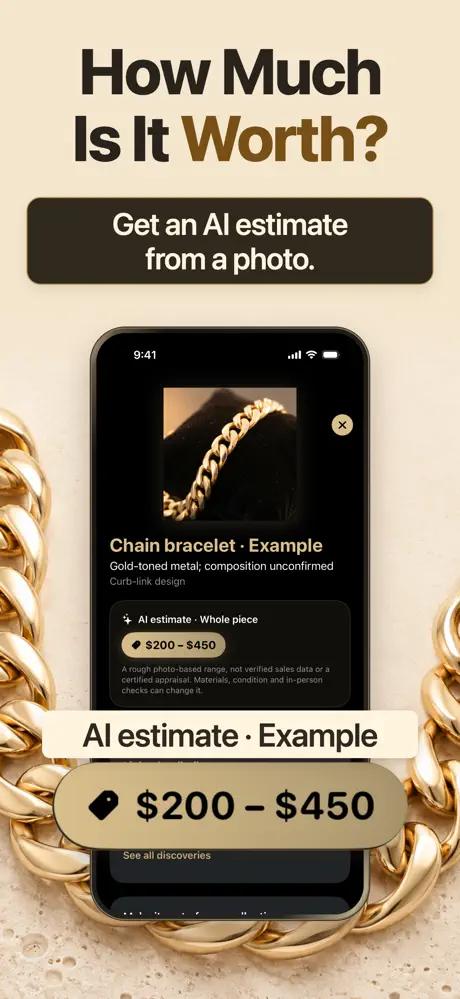
Point your iPhone camera at any ring, necklace, brooch, or earring. In under 30 seconds, JewelSnap tells you what it is, what era it's from, whether the gold and stones are likely genuine, what hallmarks mean, and what it's worth on today's market. Plus a check against public stolen-property records, including Interpol's Stolen Works of Art database.

Overview
What is JewelSnap?
JewelSnap is an iOS app built on Apple's computer vision frameworks plus a jewelry-specific model trained on reference imagery across hallmarks, gemstone optics, metal patinas, and historical design conventions.
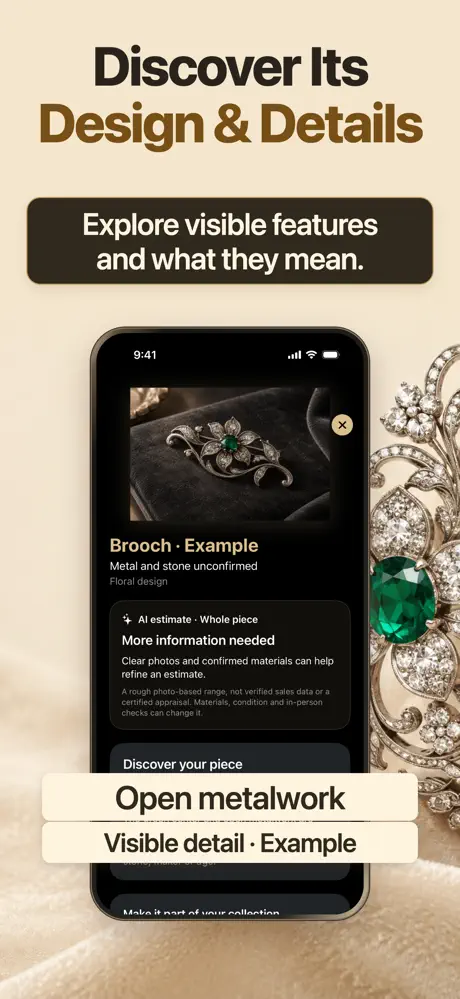
Every scan returns seven structured outputs: jewelry type classification, material analysis (gold karat, silver, platinum, plated metals), gemstone identification (diamond, ruby, sapphire, emerald, cubic zirconia, moissanite, and more), historical era dating across eight periods, authenticity verdict with a transparent confidence score (0–100%), market value estimate based on current secondary-market conditions, and hallmark decoding for stamps from over 50 countries.
JewelSnap is not a certified authentication service and does not issue legally-defensible appraisals. It is a first-filter tool that tells you whether an item is likely worth professional appraisal — and it checks scanned pieces against public stolen-property records, including Interpol's Stolen Works of Art database, before you buy.
Audience
Who JewelSnap is built for
Thrift hunters & estate sale shoppers
You browse Goodwill, garage sales, and estate sales looking for gold and silver hiding among costume pieces. You have sixty seconds to decide before someone else grabs the bin. JewelSnap turns that sixty seconds into a confident yes-or-no with an estimated value range and a stolen-property check.
Inheritance recipients
You inherited a jewelry box with 20–40 pieces. Professional appraisals run $75–150 per item — that's $1,500–6,000 just to know what you have. JewelSnap lets you sort the box in an evening: which pieces deserve a jeweler, which are costume, which might be historically significant.
Resellers on eBay, Poshmark & Mercari
You buy estate sale lots — sometimes 50–100 pieces for under $100 — and need to price each item fast. JewelSnap is built for batch workflows: photograph, scan, save to portfolio, export PDF listings. The subscription pays for itself with one accurate flip.
Sellers facing pawnshop offers
Divorce, downsizing, financial pressure — you have jewelry you need to sell and a pawnshop offer that feels low. JewelSnap gives you the rough market value before you negotiate, plus a PDF report you can take to a second-opinion buyer.
Vintage & antique collectors
You love Antiques Roadshow. You hunt Art Nouveau brooches and Victorian mourning jewelry. JewelSnap's era dating is the feature that keeps you using the app long after a single thrift find — catalog your collection, track its total value, and learn the historical context behind each piece.
Capabilities
The five features that set JewelSnap apart
- Era dating across eight historical periods — most jewelry identifier apps stop at material and value. JewelSnap separately classifies historical era: Georgian (1714–1837), Victorian (1837–1901), Edwardian (1901–1910), Art Nouveau (1890–1910), Art Deco (1920–1935), Retro (1935–1950), Mid-Century (1950–1965), and Contemporary (1965–present). An Art Deco diamond ring can be worth five times its raw-material value because of its design pedigree — the era classification is what unlocks that calculation.
- Hallmark decoder for 50+ countries — that tiny stamp inside the ring — 750, 585, 925, PT950, plus a maker's mark — tells you everything if you can read it. JewelSnap decodes purity standards and maker's marks from the United States, United Kingdom (London, Birmingham, Sheffield, Edinburgh assay offices), France, Italy, Germany, Russia, Spain, the Netherlands, Scandinavia, the Middle East, India, China, Japan, and major South American countries. Critical for inherited jewelry from immigrant families and items from international estate sales.
- Stolen-property check — against public records, including Interpol's Stolen Works of Art database. JewelSnap cross-references scanned items against public stolen-property databases including the Interpol Stolen Works of Art Database. If you're buying a high-value piece at an estate sale or online marketplace, you can verify it isn't reported stolen before money changes hands.
- AI Expert chat for follow-up questions — the initial scan returns structured data. Then ask follow-ups in plain English: "What does this maker's mark mean?", "Is this Edwardian or Art Nouveau?", "How would I describe this for an eBay listing?", "How do I clean enamel without damaging it?" The expert chat is trained on the same jewelry knowledge base as the identification model.
- PDF appraisal reports — every Pro scan can be exported as a professional PDF report for insurance documentation, estate division, resale listings on Poshmark or eBay, or your own records. The PDF includes the photo, identified material, gemstones, era, market value range, confidence scores, and the date of analysis. It explicitly notes that JewelSnap provides AI-generated estimates and is not a substitute for certified appraisal.
Workflow
How a JewelSnap scan works — three steps
- Open JewelSnap and tap the camera button.Hold your iPhone 6–12 inches from the jewelry under decent light. The app prompts you when lighting or focus is insufficient. No account required for the first three scans.
- Take 1–3 photos (front, back, hallmark close-up).For best accuracy, capture the hallmark stamp if visible — that's the single highest-information feature. The app uses macro focus on iPhone 13 Pro and later. Without a clear hallmark, accuracy on metal purity drops, but identification of stones, era, and approximate value still works.
- Read the structured verdict.Within 15–30 seconds you get the seven structured outputs plus confidence scores. Tap any field for the AI Expert chat. Save to portfolio. Export PDF. Decide whether to buy, pass, or take the piece to a gemologist.
Comparison
JewelSnap vs Jewelry Identifier — Appraisal vs Jewelry Identifier Value
An honest side-by-side across the leading iOS jewelry identifier apps. JewelSnap offers three features the other two apps here do not.
| JewelSnap | Jewelry Identifier — Appraisal (Ideas All Day) | Jewelry Identifier Value (Hai Nguyen) | |
|---|---|---|---|
| Material identification | Yes | Yes | Yes |
| Gemstone identification | Yes — 25+ stone types | Yes — common stones | Limited |
| Market value estimate | Yes, with range | Yes, point estimate | Yes |
| Era dating (Victorian, Art Deco, etc.) | Yes — 8 periods | No | No |
| Hallmark decoder | 50+ countries | US, UK, France, Germany only | No |
| Stolen property cross-check | Yes (Interpol) | No | No |
| Confidence score transparency | Yes — 0–100% per field | Implied only | No |
| AI Expert follow-up chat | Yes | Basic | No |
| PDF appraisal reports | Yes | No | No |
| Free trial | 3 free scans, no account | Variable, account required | Limited |
| Annual price | $29.99/yr | ~$39.99/yr | Varies |
| App Store rating | 4.6★ (25 ratings) | 4.69★ · 231 ratings | 4.00★ · 251 ratings |
Where Jewelry Identifier — Appraisal beats JewelSnap: larger review base (231 vs 25 ratings), lower minimum iOS version (14.0+ vs 17.0+), and more interface languages today. If you use an older iPhone or need a non-English UI, that app may suit you better. For era dating, wide hallmark coverage, stolen-property checks, and PDF export, JewelSnap is the stronger tool.
In practice
Situations where JewelSnap helps
Illustrative examples of how the features fit into a day, not user reviews.
The inherited jewelry box
Mia's grandmother left a box with 34 pieces. A jeweler quoted $75–150 per item for appraisal — up to $5,100 to know what's in the box. Instead, Mia lays out the collection on a white cloth, scans every piece with JewelSnap, and gets material, gemstone, era, and value data for each one. In two hours she identifies four pieces worth professional appraisal — a possible Art Deco diamond ring, two pieces with Russian kokoshnik hallmarks, and a brooch that might be Miriam Haskell. She takes those four to a gemologist. Total appraisal bill: $320 instead of $5,100.
The estate sale in sixty seconds
Alex is at a weekend estate sale. A gold-colored ring is priced at $35 with a faint stamp inside. He opens JewelSnap, photographs front, back, and the stamp close-up. Thirty seconds later: 18K yellow gold, Art Deco circa 1925–1930, estimated secondary-market value $380–520, confidence 82%, no stolen-property flag. He buys, lists it on eBay the same evening, sells for $440 within three days.
The pawnshop counter
Jordan needs cash and brings a necklace to a pawnshop. The offer is $80. Before accepting, she scans it with JewelSnap: sterling silver (.925), Mid-Century circa 1955–1965, estimated $160–220 on secondary market, hallmark consistent with Scandinavian silver. She declines the $80 offer, lists it on Poshmark instead, and sells for $195 in four days.
The suspicious eBay lot
Sam buys a lot of 12 pieces at an estate sale for $85. Before listing on Mercari, he scans all 12 with JewelSnap. Eleven are costume or low-value silver. One triggers a stolen-property database flag — an ornate brooch with unusual enamelwork. Sam contacts the estate executor and discovers the piece was reported stolen in a 2019 burglary. He returns it and avoids receiving-stolen-goods complications. That single check justifies the entire annual subscription.
Pricing
Simple pricing — start with three free scans
Free
$0 to start
- 3 free scans included
- No account required
- Full identification output
- iOS 17.0+
Pro Weekly
$4.99 / week
- 3-day free trial
- Unlimited scans
- AI Expert chat
- PDF appraisal reports
- Portfolio analytics
Pro Annual
$29.99 / year
- Saves over 88% vs weekly
- Unlimited scans
- AI Expert chat
- PDF appraisal reports
- Portfolio analytics
- Priority feature requests
Trial auto-converts to weekly billing unless cancelled at least 24 hours before it ends. All subscription management is handled by Apple in Settings → Apple ID → Subscriptions.
Questions
Frequently asked questions
How accurate is JewelSnap at identifying jewelry from a photo?
JewelSnap returns a confidence score (0–100%) with every scan. For well-lit photos of clearly stamped jewelry, metal-type identification accuracy is typically above 85%. Era dating and gemstone identification accuracy depend heavily on photo quality and the presence of identifying features. The app flags low-confidence results explicitly. For any item potentially worth over $1,000, the recommended workflow is: scan with JewelSnap first, then take only the high-value items to a certified gemologist.
Can JewelSnap actually tell if my gold jewelry is real?
JewelSnap analyzes hallmark stamps, color consistency, wear patterns, and craftsmanship to distinguish solid gold from costume jewelry in the vast majority of cases. It is not designed to detect very high-quality forgeries or to distinguish 14K from 18K with certainty in every case. For genuinely high-stakes verification — buying a $5,000 ring online, valuing a significant inheritance, insurance documentation — physical testing by a jeweler (acid test, electronic gold tester, density analysis) remains the gold standard. JewelSnap is a first filter, not a replacement.
What does the stamp '750' on my ring mean?
The stamp '750' indicates 18-karat gold — 750 parts per thousand are pure gold (75% pure). It's the European convention for marking gold purity. Other common gold purity stamps: 585 = 14K (58.5% pure), 417 = 10K (41.7%), 375 = 9K (37.5%), 916 = 22K (91.6%), 999 = 24K pure gold. JewelSnap automatically decodes all of these along with maker's marks and country-of-origin assay marks.
What does 'PT950' or 'PLAT' mean on jewelry?
PT950 indicates platinum that is 95% pure — the most common platinum standard for fine jewelry. PT900 is 90% pure, PT850 is 85% pure. The marking 'PLAT' alone means at least 95% platinum content in most jurisdictions. Platinum is denser and more valuable per gram than gold, so correctly identifying it matters significantly for valuation.
Can JewelSnap tell the difference between a diamond and cubic zirconia?
JewelSnap analyzes visual indicators including light dispersion, inclusion patterns, surface luster, and cut characteristics to provide a probabilistic diamond-vs-CZ assessment. For well-lit photos this is typically reliable. For definitive diamond authentication on high-value purchases, a jeweler using a diamond tester (thermal conductivity) or refractometer remains essential. JewelSnap flags uncertain cases explicitly.
Does JewelSnap identify lab-grown diamonds?
JewelSnap can sometimes flag lab-grown indicators (certain inclusion patterns, growth structure visible at high magnification), but reliably distinguishing lab-grown from mined diamonds requires specialized equipment that no smartphone app can replicate. For any diamond purchase above a few thousand dollars where mined-vs-lab status affects price significantly, request a GIA certificate from the seller.
How does the Interpol stolen property check work?
JewelSnap cross-references identifying features of scanned jewelry against public stolen-property databases, including the Interpol Stolen Works of Art Database. This is especially relevant when buying at estate sales, online marketplaces (eBay, Facebook Marketplace), or from non-traditional sellers. A match does not constitute proof of theft — it indicates further verification is warranted before completing the transaction.
What's the difference between JewelSnap and a professional jewelry appraiser?
A certified gemologist holds the jewelry in their hands, uses calibrated equipment (refractometer, polariscope, microscope, gold testers), and produces a legally-defensible valuation backed by professional liability insurance. Cost: typically $75–150 per item. JewelSnap analyzes a photograph using AI computer vision in under 30 seconds. Cost: $4.99 per week or $29.99 per year. The estimate is useful for decision-making — should I buy this thrift store ring, how should I sort this inheritance, is this pawnshop offer fair — but is explicitly not a substitute for certified appraisal in any high-stakes context. Recommendation: use JewelSnap as a first filter on every item, then take only the high-value items to a gemologist. That can turn a $4,500 inheritance appraisal bill into $200.
Does JewelSnap work on vintage and antique jewelry?
Yes — and era dating is one of the features JewelSnap is most differentiated on. The app classifies pieces across eight historical periods: Georgian (1714–1837), Victorian (1837–1901), Edwardian (1901–1910), Art Nouveau (1890–1910), Art Deco (1920–1935), Retro (1935–1950), Mid-Century (1950–1965), and Contemporary (1965–present). Era affects value significantly — an Art Deco diamond ring can be worth several times its raw-material value because of the design pedigree.
How do I get the most accurate scan results?
Three rules.
- Good lighting — natural daylight or a bright LED, never direct sunlight or harsh shadows. Avoid mixed lighting that creates color casts.
- Capture the hallmark stamp if there is one — that's the single highest-information feature in any photo. Worth a dedicated close-up.
- Three angles when possible — front, back, and macro of any markings. Macro mode on iPhone 13 Pro and later helps significantly.
What jewelry materials can JewelSnap identify?
Metals: yellow gold (10K through 24K), white gold, rose gold, sterling silver (.925), coin silver, fine silver, platinum (PT850, PT900, PT950), palladium, titanium, stainless steel, plus common plated combinations.
Gemstones: diamond, ruby, sapphire (blue and fancy colors), emerald, amethyst, citrine, garnet, peridot, aquamarine, topaz, opal, pearl (natural and cultured), turquoise, jade, lapis lazuli, onyx, plus synthetic and simulant stones (cubic zirconia, moissanite, lab-grown corundum).
Vintage materials: Bakelite, Lucite, celluloid, vulcanite, jet.
What countries' hallmarks does JewelSnap decode?
Over 50 countries. Major coverage:
- North America: United States, Canada, Mexico
- UK and Ireland: London, Birmingham, Sheffield, Edinburgh, Chester, Dublin assay offices
- Western Europe: France (Paris poinçon system), Italy (Vicenza, Arezzo, Valenza), Germany, Austria, Switzerland, Spain, Portugal, Netherlands, Belgium
- Northern Europe: Sweden, Norway, Denmark, Finland
- Eastern Europe: Russia (kokoshnik marks), Poland, Czech Republic, Hungary, Romania, Bulgaria, Greece
- Middle East: Turkey, Israel, Lebanon, Saudi Arabia, UAE
- Asia: India, China, Japan, Thailand, Indonesia
- South America: Argentina, Brazil, Chile
How much does JewelSnap cost?
The app is free to download and includes 3 free scans, no account required. After three scans, JewelSnap Pro is required for further use. Pro pricing: $4.99 per week with a 3-day free trial, or $29.99 per year (saves over 88% vs weekly billing). Pro unlocks unlimited scans, AI Expert follow-up chat, PDF appraisal reports, portfolio analytics, era dating, hallmark decoding, and stolen property cross-check.
How do I cancel my JewelSnap subscription?
JewelSnap subscriptions are managed through Apple's standard subscription system. To cancel:
- Open the Settings app on iPhone
- Tap your Apple ID at the top of the screen
- Tap Subscriptions
- Find JewelSnap in the list
- Tap Cancel Subscription
Cancellation takes effect at the end of the current billing period. The 3-day free trial can be cancelled at any time before it ends with no charge.
Can I export my scans for insurance or legal purposes?
Yes — Pro subscribers can export PDF appraisal reports for any scan. The report includes the photograph, identified material, gemstones, era, market value range, confidence scores, and date of analysis. The PDF explicitly notes that JewelSnap provides AI-generated estimates and is not a substitute for certified appraisal. It functions as preliminary documentation, not a legal valuation. For insurance claims or estate division, a certified appraisal is still required — but the JewelSnap PDF can streamline that process by letting the appraiser confirm or correct the AI's findings rather than starting from scratch.
Does JewelSnap work on costume jewelry?
Yes. JewelSnap identifies costume jewelry as costume, including common materials (gold-plated brass, silver-plated copper, base metal, lucite). For vintage costume jewelry — Bakelite, Trifari, Coro, Hobé, Miriam Haskell, Eisenberg, Schiaparelli — the app often identifies the era and sometimes the maker. Many vintage costume pieces have meaningful collector value (a Schiaparelli surrealist piece from the 1930s can fetch thousands of dollars at auction).
Is my photo data private when I use JewelSnap?
Photos uploaded to JewelSnap are processed for identification and stored in your private jewelry portfolio (if you choose to save them). They are not shared with third parties or used to train external AI models without your explicit consent. Anonymous scan metadata may be used to improve the JewelSnap AI model. The full privacy policy is available at love8ko.github.io/jewelsnap/privacy-policy.html.
Does JewelSnap work without internet?
No — JewelSnap requires an internet connection because the AI identification model and stolen-property database run on cloud servers. Photo upload, AI processing, and verdict delivery typically complete in 15–30 seconds on a good connection. Saved scans in your portfolio can be viewed offline once they're cached on your device.
What if JewelSnap identifies my jewelry incorrectly?
Check the confidence score first. If it was low (under 60%) and the app flagged the result as uncertain, retake the photo in better light with the hallmark visible, or try another angle. If the score was high and the result still looks wrong, take the piece to a jeweler.
How is JewelSnap different from other jewelry identifier apps?
Three features no competitor offers: era dating across eight historical periods (Georgian through Contemporary), hallmark decoding for over 50 countries, and stolen property cross-check. Plus higher transparency on confidence scoring (every result includes a 0–100% confidence score per field) and exportable PDF appraisal reports for insurance and resale documentation.
Jewelry Identifier — Appraisal (Ideas All Day) holds 4.69 stars from 231 ratings; Jewelry Identifier Value (Hai Nguyen) holds 4.00 stars from 251 ratings. More review volume and comparison context at Best jewelry identifier apps of 2026.
Start with three free scans. No account needed.
More from the studio
Related Loveiko Labs apps
What JewelSnap is and is not. JewelSnap provides AI-generated estimates for informational purposes only. Results are not a substitute for professional jewelry appraisal. Always consult a certified gemologist or appraiser credentialed by the Gemological Institute of America (GIA), American Gem Society (AGS), or equivalent professional body for official valuations, insurance documentation, or authentication of high-value items.
JewelSnap is not affiliated with, endorsed by or sponsored by any luxury jewelry brand, auction house, or professional appraisal body. The Interpol Stolen Works of Art Database cross-reference is a supplementary check — a match does not constitute proof of theft and a non-match does not guarantee clean provenance.
For transactions above $1,000, insurance documentation, estate tax filings, or legally-defensible authentication, pair any AI-based reference check with a certified physical appraisal by a GIA or AGS credentialed gemologist.