
iOS App · Supplement Tracker · Drug Interaction Checker
StackSnap — your supplement shelf, audited.
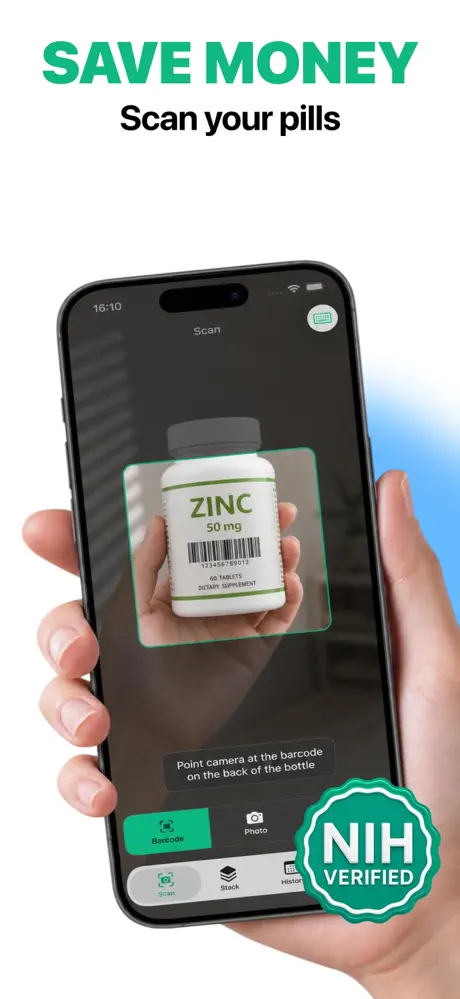
If you take several supplements, it is easy to double up on an ingredient or lose track of what the stack costs. StackSnap scans any bottle, breaks down every ingredient using the NIH DSLD database (130,000+ products), and shows you exactly what you're spending versus what you're saving. Plus a drug interaction check to review with your pharmacist.
Overview
What is StackSnap?
StackSnap is an iOS supplement tracker and drug interaction checker that scans any supplement bottle, identifies every ingredient from the NIH DSLD database (130,000+ products), and shows you exactly what you're spending versus what you could be saving — in actual dollars.
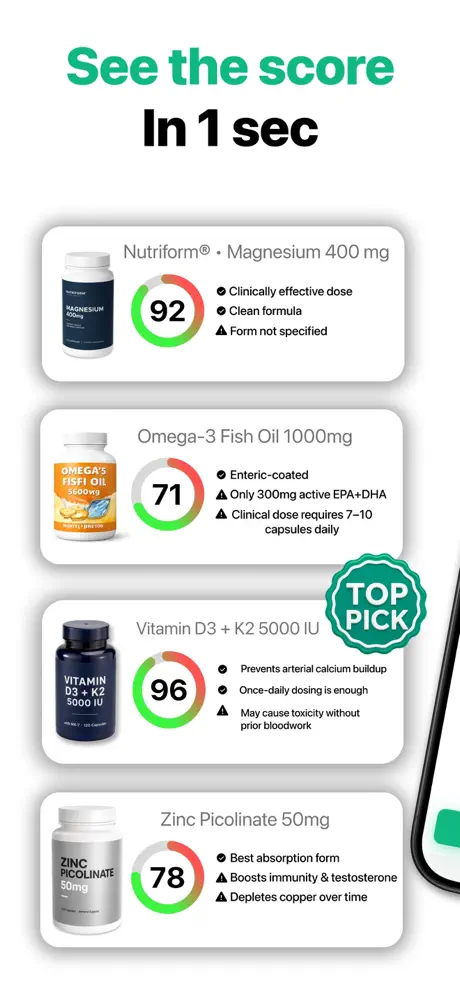
Two well-funded supplement tracker apps have hundreds of thousands of users — SuppCo and Prove It. Both show you "TrustScores" (proprietary ratings that change without explanation). Neither shows you the only number that actually matters to most people on supplements: how much money you're wasting.
StackSnap is built differently. Every duplicate ingredient your stack contains, every potential overdose, every cheaper alternative for the same ingredient — quantified as actual dollars. The home screen shows "Saved this month: $87" based on what the audit identified.
StackSnap is a general wellness app — not a medical device. It pulls scan results directly from publicly verifiable government databases (NIH DSLD and RxNav), not black-box proprietary ratings.
Audience
Who StackSnap is built for
Wellness enthusiasts with complex stacks
You follow biohackers on podcasts. You take Alpha-GPC for cognition, Lion's Mane for nerve growth, Bacopa for memory, L-Theanine with caffeine, magnesium glycinate at night, vitamin D with K2 in the morning. You spend $150+/month and aren't entirely sure your $40 nootropic blend isn't just expensive caffeine. StackSnap audits the whole stack and shows you exactly what's redundant and what's evidence-based.
Anyone managing prescriptions alongside supplements
You take 8–15 supplements plus 3–5 prescriptions — statins, blood pressure medications, thyroid, or blood thinners. You worry that your fish oil might be too much with your blood thinner, that your turmeric is doing something to your thyroid medication. StackSnap's RxNav-powered interaction checker flags potential interactions the moment you scan a new supplement — using the same database pharmacists consult.
Newly diagnosed patients building a protocol
Your doctor told you you're pre-diabetic, or you have Hashimoto's, or you're starting hormone replacement therapy. You've started buying berberine, alpha-lipoic acid, CoQ10, selenium, vitamin D. You want to walk into your endocrinologist's office with a clean 1-page printout instead of fumbling through 12 bottles. StackSnap's doctor PDF export does this in one tap.
Caregivers managing a family member's stack
Your aging parent takes 12 things every day across two trays and four prescriptions. You're worried something will interact, or they'll forget a dose, or there's a duplicate you haven't noticed. StackSnap centralizes everything, sets up smart reminders, and flags any interaction risks.
Capabilities
The seven features that matter most
- Savings counter on the home screen — quantifies money saved through identified duplicates, overdoses, cheaper alternatives, and low-evidence supplements. Updates monthly. The first feature in the supplement-tracker category to show dollars instead of scores.
- Drug interaction checker (powered by RxNav) — RxNav is the National Library of Medicine's drug interaction reference — the same dataset pharmacists use to flag risky combinations. Add your prescriptions once, and StackSnap warns you the moment you scan a supplement that might interact (cytochrome P450 effects, absorption competition, blood-thinning additivity). Always confirm flags with your pharmacist before any change.
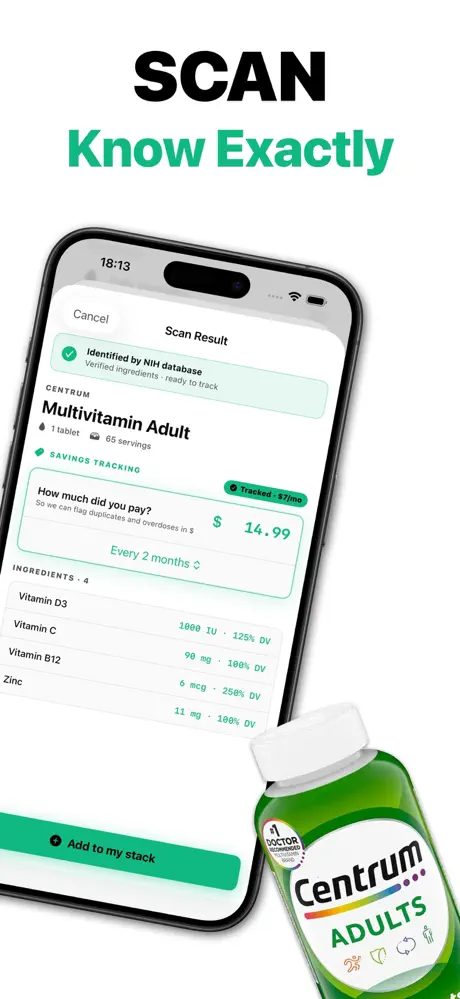
- NIH DSLD ingredient breakdown — over 130,000 supplement products indexed by the U.S. National Institutes of Health. Every ingredient and amount is source-cited to the DSLD entry — no proprietary "TrustScores" that change without explanation. You can verify any data point against the public NIH database directly.
- Smart timing reminders — morning vitamin D, evening magnesium, berberine with food, melatonin 30 minutes before bed, fat-soluble vitamins with the largest meal. StackSnap organizes timing based on general wellness guidelines and the specific ingredient profile of what you're taking.
- 1-page doctor-ready PDF — when your healthcare provider asks "what are you taking?" hand them a clean, organized one-page summary. Brand, ingredient, daily amount, schedule, and any flagged interactions. Saves five minutes of fumbling at every appointment and gives your doctor real information to work with.
- Transparent benchmark pricing — for 25 popular ingredients, StackSnap shows whether you're paying above or below the U.S. median price per serving. Multi-marketplace price comparison across iHerb, Amazon Health, and Vitacost. No more guessing whether $40 for 60 capsules of magnesium is fair.
- Honest 7-day free trial — full Pro access from day one. No 20-question quiz before you see the app, no email signup gate, no fake countdown timers, no guilt screens. Cancel in two taps.
Workflow
How a StackSnap audit works — 20 minutes, six steps
- Pull every supplement bottle off your shelf.Don't skip the ones you take occasionally, or the one you bought six months ago and forgot about. Lay them all out. Many people are surprised — "I thought I took maybe six, it's actually eleven."
- Open StackSnap and scan each bottle one at a time.Point at the front label and supplement facts panel — both visible for best results. Barcode scanning also works for most US-marketed products in the NIH DSLD database. Average scan time: under 10 seconds per bottle.
- Watch the savings counter populate as duplicates are flagged.The home screen tallies in real time. Common first-pass findings: your multivitamin's magnesium overlaps with your separate magnesium glycinate; your B-complex contains 100% RDA of B12 while your sublingual contains 16,000% RDA; your "joint blend" duplicates the glucosamine you take separately.
- Add your prescriptions for the interaction check.If you take any prescription medication, add it now (drug name search or scan the prescription label). The RxNav-powered checker flags any interactions. Common flags: fish oil + warfarin, St. John's Wort + SSRIs, turmeric + blood thinners, vitamin K + warfarin.
- Review benchmark pricing for your top ingredients.For 25 popular supplements, StackSnap shows whether your brand is above, at, or below the U.S. median price per serving. The brand premium is sometimes $10–30/month on a single supplement — often justified for specific quality reasons, sometimes not.
- Export the doctor PDF for your next healthcare visit.One-page summary of every supplement, your prescriptions, any flagged interactions, and your daily schedule. Saves 5–10 minutes of fumbling at your next physical, pharmacy consultation, or specialist visit.
Comparison
StackSnap vs SuppCo vs Prove It
An honest side-by-side. Full disclosure: StackSnap is our app. We've tried to be honest about where SuppCo wins.
| StackSnap | SuppCo | Prove It | |
|---|---|---|---|
| Ingredient identification | Yes — NIH DSLD source | Yes — proprietary DB | Yes — proprietary DB |
| Source verifiability | Yes — public NIH database | Proprietary scoring | Proprietary scoring |
| Dollar savings counter | Yes — actual $$$ | No (TrustScore only) | No |
| Drug interaction checker | Yes — RxNav (pharmacist DB) | No | Limited |
| Doctor PDF export | Yes — 1-page | No | No |
| Smart timing reminders | Yes — per-ingredient | Basic | Basic |
| Multi-marketplace pricing | iHerb / Amazon / Vitacost | No | No |
| Local-first storage | Yes — SwiftData, no data loss | Cloud-only | Cloud-only |
| 7-day free trial (full Pro) | Yes — no quiz | Quiz before paywall | No (dark pattern) |
| Annual price | $39.99 | ~$69–79 | ~$99–200 |
| App Store rating | 4.8★ (12 ratings) | 4.8★ (30K+ ratings) | 4.4★ (15K+ ratings) |
The fundamental difference: SuppCo uses proprietary "TrustScores" — composite ratings whose formula is opaque; users have no way to verify why one supplement got 7.2 and another got 6.4. StackSnap shows actual dollars instead of scores, with ingredient data sourced directly to verifiable NIH DSLD entries. Prove It (4.4★, 15K+ ratings) centers on its own product scores and testing data. StackSnap focuses on duplicates, upper limits and what your stack costs.
In practice
What an audit can look like
The wellness enthusiast — $168/month stack
An illustrative example. Monthly spend before audit: $168. Multivitamin ($32/mo) already provides 50% of daily magnesium — overlapping with separate magnesium glycinate ($18/mo) and pushing combined intake above tolerable upper limits. B-complex + sublingual B12 combined at 16,000% RDA. "Memory blend" nootropic ($40/mo) with seven substances with no published evidence for the stated combination. Fish oil and turmeric both flagged for interaction with prescribed blood thinner — requires doctor review. Total identified monthly savings: $61–$105, with the interaction flags potentially preventing a more serious medication problem.
The "concerned about getting older" stack
Typical profile: 6–10 supplements for general healthy aging. Most common duplicates: multivitamin + bone health blend (both with vitamin D and K), heart health formula + fish oil (both with omega-3). Most common low-evidence purchase: collagen supplements with debated efficacy for most stated claims. Estimated monthly savings in this example: $40–$90.
The newly diagnosed protocol
Typical profile: 5–8 supplements added after a new diagnosis — T2D, Hashimoto's, MTHFR variant, hypertension. Most common issue: not duplicates (the stack is intentional), but interaction risks with prescribed medications. Berberine, alpha-lipoic acid, CoQ10, selenium, vitamin D each needing clearance. Highest-value use of the audit: the doctor PDF for the next endocrinologist visit — one tap, full picture, five minutes saved. Savings less critical than interaction safety here.
Pricing
Simple pricing, no dark patterns
Weekly
$4.99 / week
- 7-day free trial
- Full Pro access — no quiz
- Unlimited scans
- Drug interaction checker (RxNav)
- NIH DSLD ingredient breakdown
- Savings counter
- Doctor PDF export
Annual
$39.99 / year
- Saves over 84% vs weekly
- Everything in Weekly
- Smart timing reminders
- Multi-marketplace pricing
- Goal-based stack templates
- HealthKit integration
- Your data stays on your iPhone
Trial auto-converts to weekly billing unless cancelled at least 24 hours before it ends. All cancellation is handled by Apple in Settings → Apple ID → Subscriptions. Many stacks have at least one duplicate or over-limit ingredient worth reviewing.
Questions
Frequently asked questions
How does StackSnap calculate the savings counter?
Four categories of avoided cost:
- Duplicate ingredients — two supplements containing overlapping active ingredients (your multivitamin has magnesium and you also take a separate magnesium glycinate)
- Potential overdoses — amounts above tolerable upper intake levels (for example, zinc or vitamin D from a multivitamin plus a separate supplement)
- Low-quality brand premium — where you pay significantly above U.S. median for the same ingredient
- Supplements with no published evidence for the stated benefit
The dollar number reflects what the average user could redirect by acting on findings. Actual savings depend on which supplements you choose to discontinue or replace — StackSnap shows the information, you make the call.
How accurate is the drug interaction checker?
StackSnap uses RxNav — the National Library of Medicine's drug interaction reference database. Same dataset pharmacists consult.
Interactions are based on documented mechanisms: cytochrome P450 effects (drugs metabolized through liver enzymes), absorption competition (iron vs calcium), blood-thinning additivity (fish oil + warfarin), blood-pressure compounding (potassium + ACE inhibitors), etc.
This is a screening tool, not a medical diagnosis. Always confirm any flagged interaction with your pharmacist or doctor before changing any supplement or medication.
What is the NIH DSLD database?
The NIH Dietary Supplement Label Database (DSLD) is a U.S. National Institutes of Health database indexing over 130,000 supplement product labels with the ingredient amounts as printed on each label.
StackSnap pulls scan results directly from DSLD rather than using proprietary "TrustScore" systems that change without explanation. Every ingredient you see has a documented government-database source — verifiable in the public NIH database.
Is StackSnap a medical device or does it give medical advice?
No. StackSnap is a general wellness app designed to help organize and understand your supplement routine. It is not a medical device, is not FDA-cleared as such, and does not provide medical advice, diagnosis, or treatment recommendations.
Always consult a qualified healthcare professional — your doctor, pharmacist, or registered dietitian — before starting, stopping, or changing any supplement or medication. Do not disregard professional medical advice based on information from this app.
Will StackSnap diagnose what I should take?
No. StackSnap is an organizational and informational tool, not a recommendation engine.
It tells you what you are taking, what overlaps exist, what amounts are above standard upper intake levels, and what interactions might exist with your prescriptions. It does not tell you what you should take — that's a decision to make with your doctor or registered dietitian.
What supplement categories does StackSnap work on?
Broadly: anything indexed in NIH DSLD.
- Vitamins — A, B-complex (B1, B2, B3, B5, B6, B7, B9, B12), C, D, E, K
- Minerals — calcium, magnesium, zinc, iron, selenium, chromium, iodine, potassium
- Amino acids — L-theanine, glutamine, taurine, BCAAs, lysine, tryptophan
- Herbals — turmeric, ashwagandha, ginkgo, milk thistle, rhodiola, ginger
- Nootropics — Alpha-GPC, Lion's Mane, Bacopa, Phosphatidylserine, Citicoline
- Other — omega-3s, probiotics, protein powders, pre-workout supplements, sleep aids (melatonin, valerian, L-tryptophan), adaptogens
Does StackSnap have a drug interaction database for prescriptions?
Yes. RxNav covers FDA-approved prescription medications and their documented interactions with supplements and other drugs.
Add your prescriptions once (input by drug name or scan the prescription label), and StackSnap automatically cross-references them whenever you scan a new supplement.
What is the doctor PDF and when should I use it?
A clean 1-page PDF summary of every supplement in your stack: brand, ingredient, daily amount, timing, any flagged interactions or potential overdoses.
Use before any healthcare provider visit:
- Primary care annual exams
- Endocrinologist visits
- Pharmacist consultations
- Naturopath sessions
- Pre-op consultations (some supplements affect bleeding and anesthesia)
Saves 5–10 minutes of fumbling through bottles and gives your provider real information to work from.
Can StackSnap remind me when to take each supplement?
Yes. Smart reminders organize by recommended timing:
- Fat-soluble vitamins (A, D, E, K) — with the largest meal
- Magnesium glycinate — at night for sleep support
- B-complex — morning, away from caffeine
- Berberine — with carb-heavy meals
- Melatonin — 30 minutes before sleep
- Iron — away from coffee and dairy
All reminders are customizable. You can set per-supplement schedules.
What is the difference between weekly and annual subscription?
Identical features. Weekly is $4.99/week (best for short-term tracking during a new health protocol or supplement experiment). Annual is $39.99/year (saves over 84% vs weekly). For most users who scan their stack once or twice a month and review interactions periodically, annual is the better economic choice.
How do I cancel StackSnap Pro?
All subscriptions managed through Apple. To cancel:
- Open Settings
- Tap your Apple ID at the top
- Tap Subscriptions
- Find StackSnap → tap Cancel Subscription
Takes effect at end of current billing period. The 7-day trial can be cancelled any time before it ends with no charge.
Where does my data go? Is it private?
StackSnap uses SwiftData local-first storage — your supplement stack data is stored on your iPhone first, with iCloud sync optional.
Anonymous scan metadata may be used to improve the AI model. Health-related data is never shared with third parties or used for advertising. Full privacy policy: love8ko.github.io/stacksnap/privacy-policy.html.
Will I lose my stack data if I cancel?
No. Your scanned stack data persists locally on the device even after cancellation or sign-out.
You retain read access to historical scans, the doctor PDF feature, and your stack list — but lose access to new scans, the interaction checker, and ongoing reminders unless you resubscribe.
Does StackSnap track supplements I bought from non-US brands?
Coverage is strongest for U.S.-marketed brands indexed by NIH DSLD. For European, Australian, or Asian brands not in DSLD, you can manually enter the ingredient list and StackSnap will check it against the same overlap and interaction logic.
The NIH database keeps growing — coverage improves over time.
Can StackSnap detect counterfeit or fake supplements?
No. Counterfeit detection requires lab testing of the contents. StackSnap reads the label and the database entry, not the actual substance in the bottle.
For verifying authenticity of expensive or rare supplements, third-party testing (LabDoor, ConsumerLab) is necessary. StackSnap can flag suspicious patterns (unusually low price for a high-end ingredient, unlisted manufacturer) but cannot confirm or rule out counterfeits.
Is StackSnap suitable for tracking my child's supplements?
StackSnap is designed for adult supplement tracking. Pediatric dosing has different upper intake limits, age-specific interaction profiles, and considerations that StackSnap is not specifically calibrated for.
The doctor PDF feature still works for organizing the list for pediatric visits — but always consult a pediatrician for dosing or interaction questions specific to children.
Does StackSnap work with HealthKit?
Yes. StackSnap integrates with Apple HealthKit so your supplement schedule and adherence can sit alongside your other health data (workouts, sleep, prescriptions). HealthKit integration is optional and can be enabled or disabled in Settings.
What happens if StackSnap flags an interaction with my medication?
You see an alert with:
- Specific mechanism — e.g. "St. John's Wort accelerates the metabolism of many medications via CYP3A4 induction, potentially reducing efficacy"
- Severity classification — theoretical, mild, moderate, severe
- Recommendation — consult your pharmacist or doctor before making any changes
Never stop a prescribed medication based on a StackSnap flag — always speak to your prescribing physician first. The flag is the AI noticing a documented risk; the clinical judgment about what to do is your healthcare provider's.
How does StackSnap compare to SuppCo and Prove It?
SuppCo (30K+ App Store ratings) shows proprietary TrustScores that fluctuate without explanation. StackSnap shows you dollar-savings from your specific stack plus the underlying ingredient data sourced directly to NIH DSLD entries.
Prove It (4.4★, 15K+ ratings) centers on its own product scores and testing data.
StackSnap offers full Pro access during the 7-day trial, no quiz, transparent pricing, RxNav interaction checks, doctor PDF export.
How much does StackSnap cost?
7-day free trial with full Pro access. No 20-question quiz before you see the app, no email signup gate, no credit card required upfront.
After trial:
- Weekly: $4.99/week
- Annual: $39.99/year (saves over 84% vs weekly billing)
Cancel in two taps via Settings > Apple ID > Subscriptions. No quiz, no email gate, no surprise charges.
Stop guessing what's on your supplement shelf.
More from the studio
Related apps and reading
What StackSnap is and is not. StackSnap is a general wellness app designed to help you organize and understand your supplement routine. It is not a medical device and does not provide medical advice, diagnosis, or treatment recommendations. Information in this app is drawn from publicly available databases (NIH DSLD, RxNav) and general wellness guidelines and is intended for educational and informational purposes only.
Always consult a qualified healthcare professional — such as your doctor, pharmacist, or registered dietitian — before starting, stopping, or changing any supplement or medication. Do not disregard professional medical advice based on information provided by this app. Drug-supplement interactions can have serious health consequences and require professional clinical judgment to navigate safely.
StackSnap is not affiliated with, endorsed by, or sponsored by the National Institutes of Health, the National Library of Medicine, or any supplement brand. NIH DSLD and RxNav are cited as the data sources used; StackSnap is an independent app that queries those public databases.